Gaur
Largest living bovid, native to South and Southeast Asia.

Ghedoghedo · Public domain
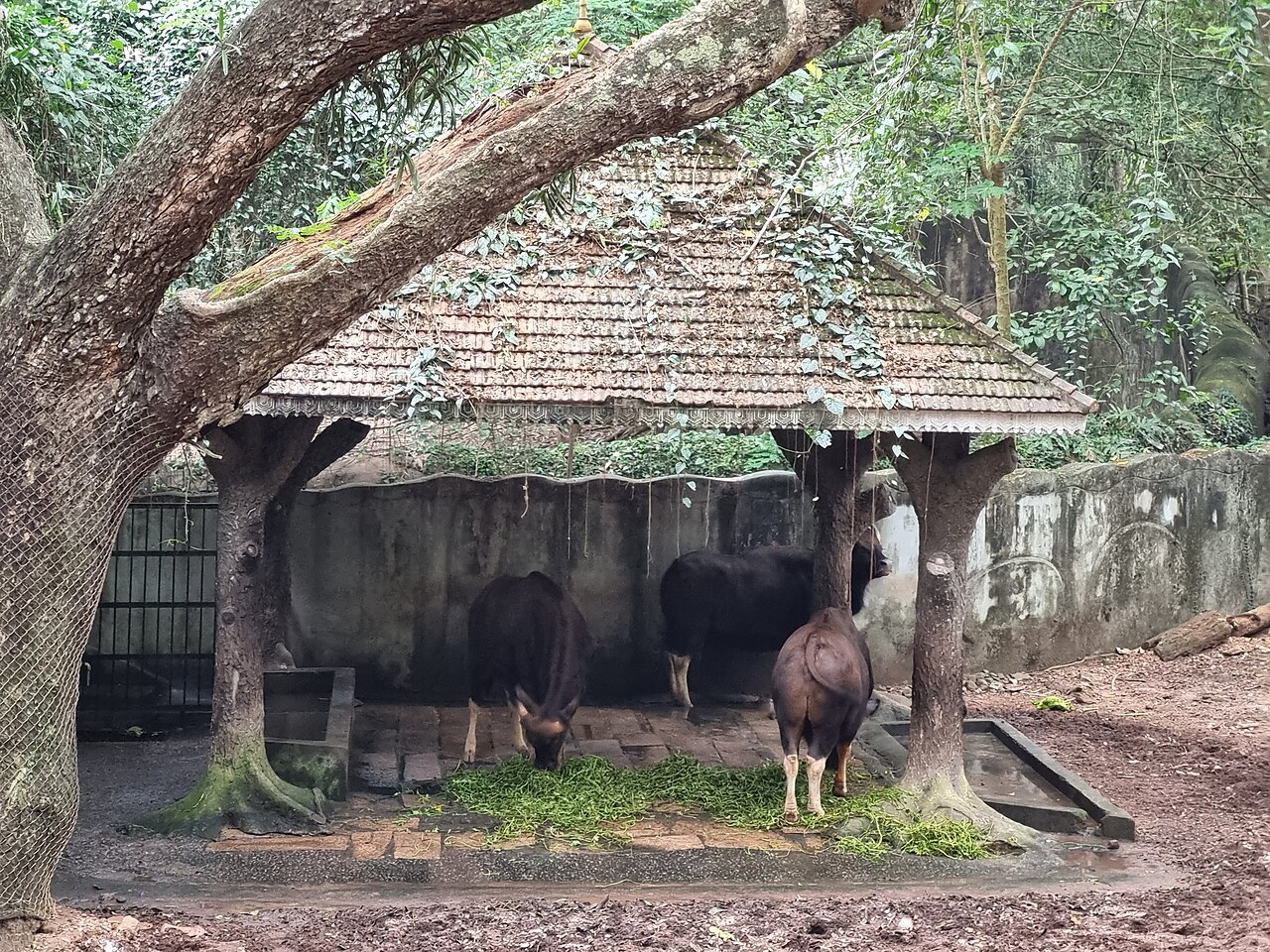
The gaur (Bos gaurus), also known as the Indian bison, is a large bovine native to the Indian subcontinent and Southeast Asia. It is the largest species among wild cattle and the Bovidae.
Lore & Background
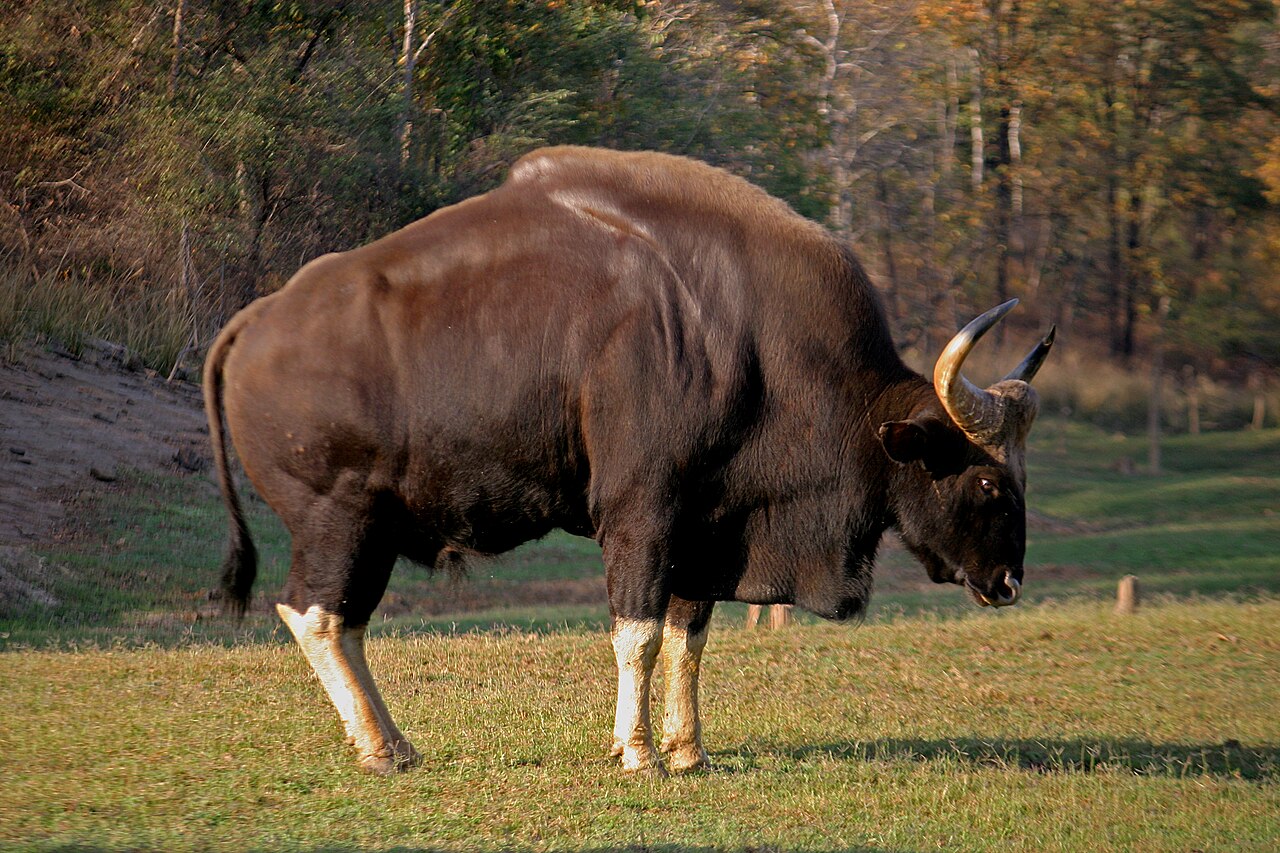
The gaur is a strong, massively built bovine with a high convex ridge on the forehead between the horns, a prominent ridge on the back, and very large ears. Adult males are dark brown to black, with ashy grey on the upper head; cows and young bulls are paler, sometimes with a rufous tinge. The domesticated gayal or mithun is a domesticated form of the gaur and is most common in border regions of Northeast India, Bangladesh, Myanmar, and Yunnan, China.
Reader's Guide
The gaur historically occurred throughout mainland South and Southeast Asia, but its range is now seriously fragmented, and it is regionally extinct in Peninsular Malaysia and Sri Lanka. The gaur is most closely related to the banteng and the probably now extinct kouprey. Its conservation significance lies in its status as a vulnerable species facing habitat loss and fragmentation across its remaining range.
Did You Know?
- The Sanskrit word 'gaura' means 'white, yellowish, reddish'.
- The gaur has a distinct dewlap on the throat and chest.
- Males are about one-fourth larger and heavier than females.
- The gaur is most closely related to the banteng and the kouprey, though the kouprey's status as a separate species is debated.
Physical Majesty: The Largest Bovid Alive
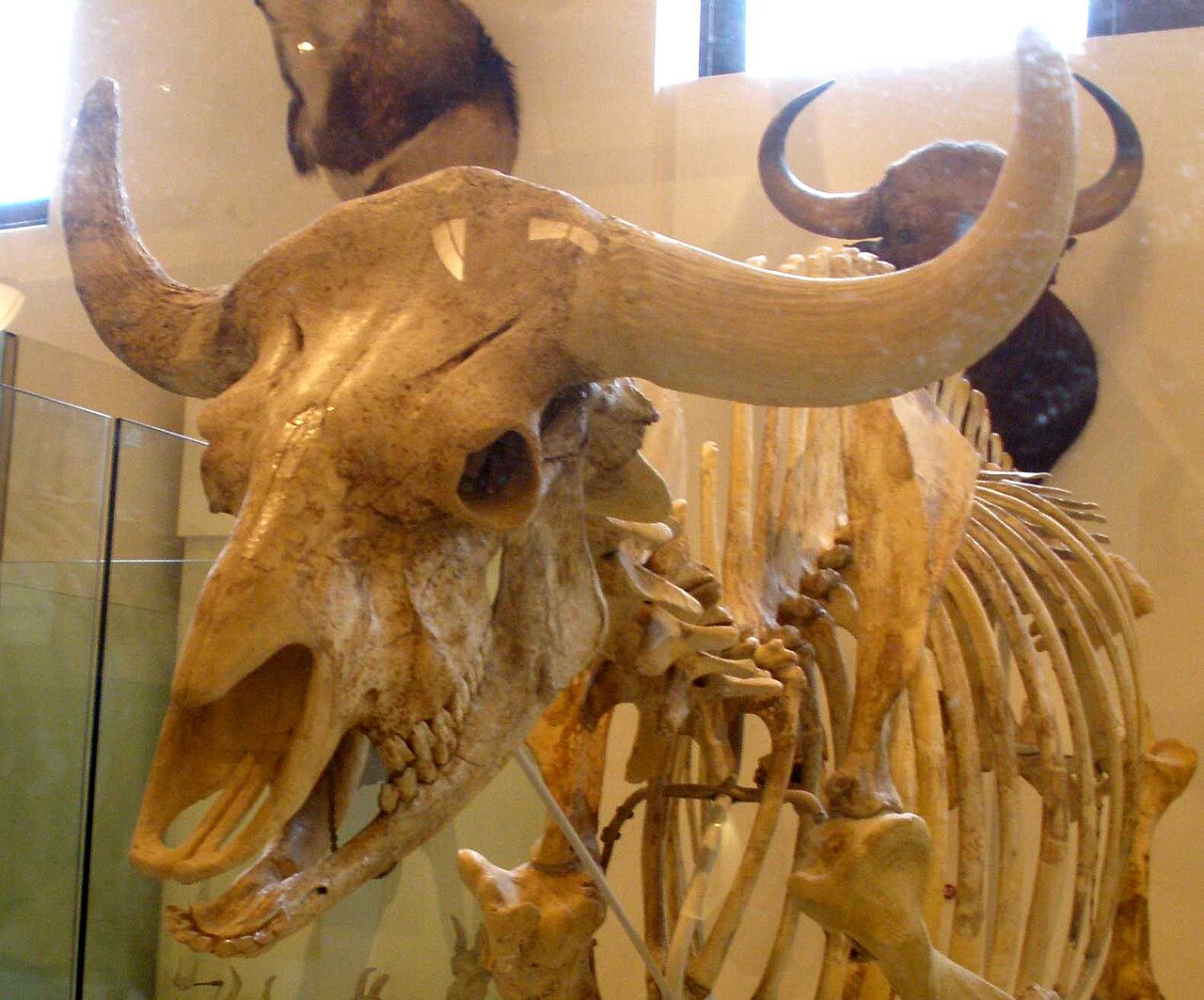
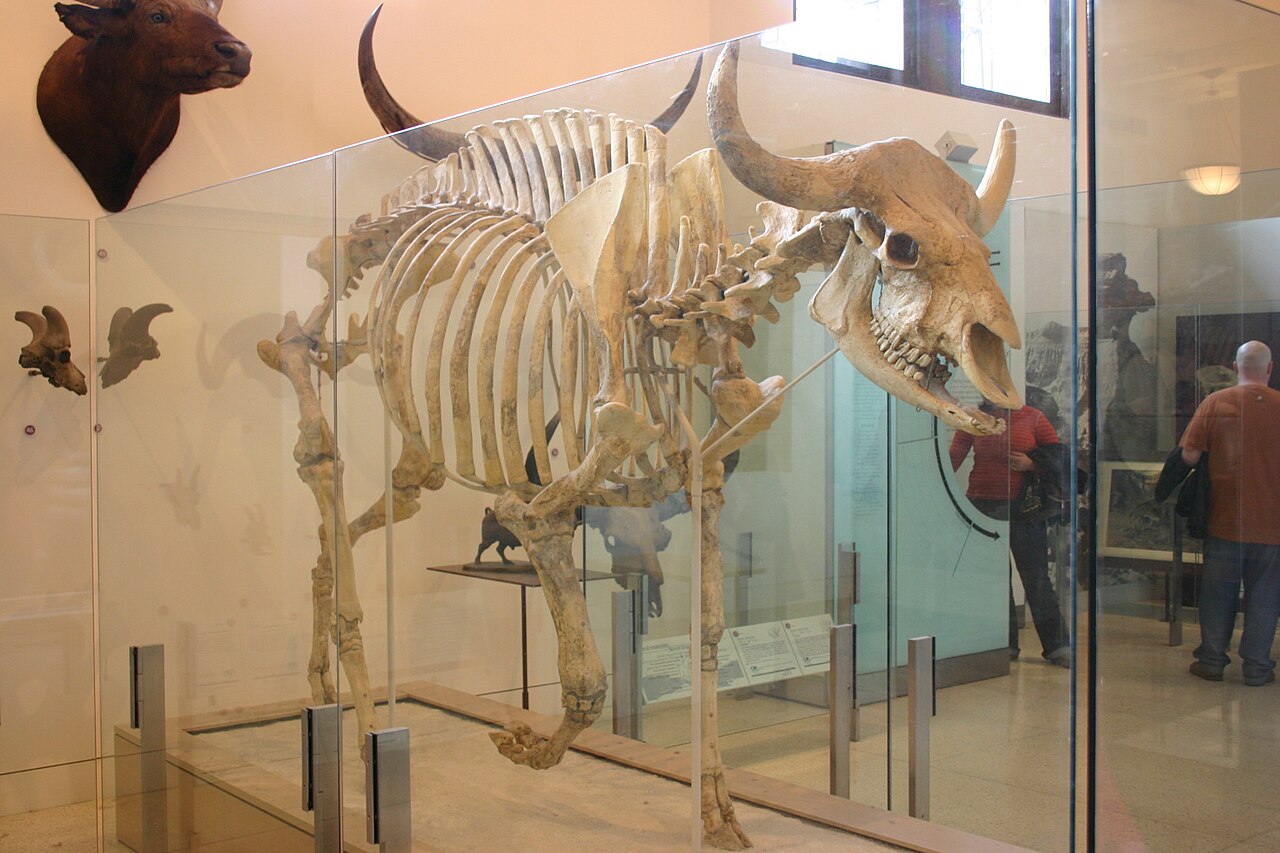
The gaur holds the title of the largest living member of the Bovidae family, a distinction reflected in every dimension of its build. Adult males stand between 142 and 220 centimetres at the shoulder, with the muscular hump just behind the shoulders pushing that figure to just under 200 centimetres. Body mass spans an extraordinary range: females tip the scales anywhere from 440 to 1,000 kilograms, while males reach between 588 and 1,500 kilograms, making them roughly a quarter heavier than their female counterparts. The animal's silhouette is defined by a pronounced dorsal ridge running from the shoulders to mid-back, a feature produced by elongated spinous processes in the fore-trunk vertebrae; the shoulders can sit as much as twelve centimetres above the rump. Old bulls darken to near-black, while their heads carry an ashy-grey wash and their lower legs flash pure white. Both sexes bear horns of 60 to 115 centimetres, pale greenish-yellow along most of their length with black tips, curving upward and inward from the sides of the skull.
A Shattered Range: Habitat and Conservation
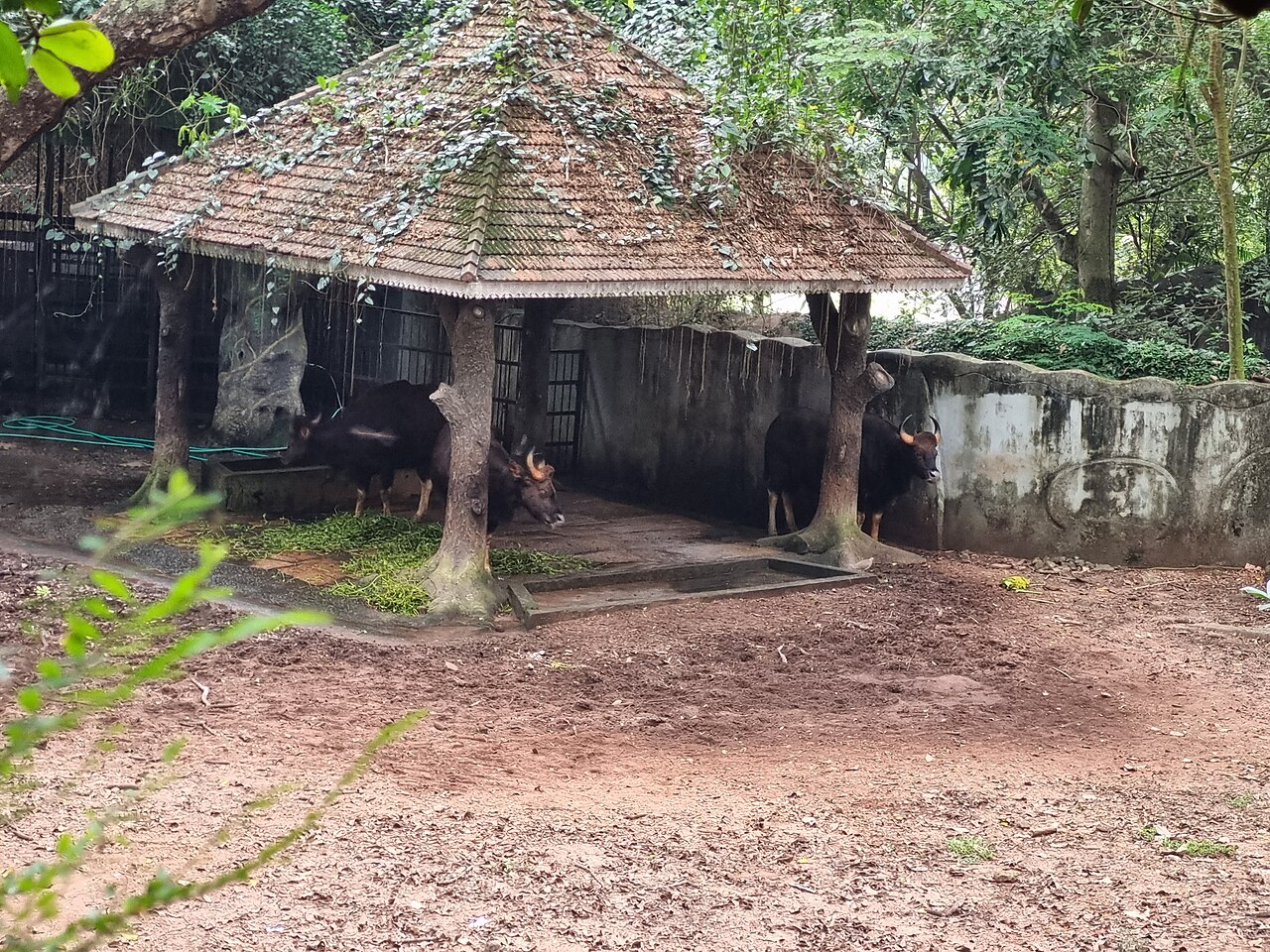
Historically the gaur roamed across the full breadth of mainland South and Southeast Asia, from Nepal and India through Bhutan, Bangladesh, Myanmar, Thailand, Laos, Cambodia, Vietnam, and into China. Today that once-continuous distribution is seriously fragmented, and the species has disappeared entirely from Peninsular Malaysia and Sri Lanka. The IUCN Red List has classified the gaur as Vulnerable since 1986, and a 2016 estimate placed the global population at no more than 21,000 mature individuals, the great majority of them surviving in India. The animal favours large, relatively undisturbed tracts of evergreen, semi-evergreen, or moist deciduous forest, typically on hilly terrain below 1,500 to 1,800 metres elevation where water is accessible and forage—grasses, bamboo, shrubs, and browse—abounds. Its apparent preference for hills may owe as much to human activity as to biology: much of the lowland and plain habitat has already been converted to cropland and pasture, leaving the gaur squeezed into the remaining forested highlands.
Names and Lineage: A Taxonomic History
The scientific naming of the gaur carries a layered history. Charles Hamilton Smith first proposed the binomial Bison gaurus in 1827, but subsequent taxonomists debated whether the species belonged under Bos or the intermediate genus Bibos. Three subspecies were eventually recognised: the nominate B. g. gaurus spanning India, Nepal, and Bhutan; B. g. readei, described by Richard Lydekker in 1903 from a Myanmar specimen and thought to range from Upper Myanmar down to the Tanintharyi Region; and B. g. hubbacki, also Lydekker's work from 1907, based on a Pahang specimen in Peninsular Malaysia. In 2003 the International Commission on Zoological Nomenclature resolved the long-standing nomenclatural dispute by fixing Bos gaurus as the valid specific name for the wild animal, a decision most authors have since adopted. Provisionally, the trinomials Bos gaurus gaurus and Bos gaurus laosiensis are accepted pending further morphometric and genetic investigation. The common name itself traces back to Sanskrit gaura, meaning white, yellowish, or reddish, and to Hindi gaur, carrying the sense of fair or light-coloured.
From Wild Ancestor to Domesticated Kin
The gaur's influence extends well beyond the wild forest. The domesticated gayal, also called the mithun, originated partly from the wild gaur and today thrives in the border regions of Northeast India—Assam, Manipur, and Nagaland—as well as in Bangladesh, with populations also found in Myanmar and Yunnan province in China. This domestic lineage represents one of the most tangible links between the gaur and human agricultural life in the region. Within the broader genus Bos, nuclear-genome research published by Sinding and colleagues in 2021 placed the gaur as closest in kinship to the banteng (Bos javanicus) and to the kouprey (Bos sauveli), a species that is probably now extinct. All three share a Southeast Asian origin, underscoring that the gaur's evolutionary neighbourhood is fundamentally a South and Southeast Asian one. The gaur thus sits at a crossroads: the largest wild bovid on the continent, the partial ancestor of a valued domestic animal, and a close relative of species that have already vanished from the wild.
Gallery
Frequently Asked Questions
Who is Gaur?
Gaur is the largest living member of the bovid family, a massive wild bovine that roams forested regions across the Indian subcontinent and parts of Southeast Asia. It is commonly called the Indian bison, though taxonomically it is not a true bison at all.
What are Gaur's powers or role in its habitat?
Standing taller than any other wild cattle species, Gaur dominates its forest environment with sheer size and typically moves in small social groups. Its grazing and browsing habits help open up dense woodland, shaping the vegetation structure around it.
Why is Gaur important?
As the biggest wild bovid on the planet, Gaur sits near the top of its regional food web and plays a key role in structuring forest ecosystems. Its presence in a landscape is often a sign that the habitat is healthy enough to support very large herbivores.
What is Gaur's origin story?
Gaur (Bos gaurus) is indigenous to the tropical and subtropical forests of South and Southeast Asia, where it has coexisted with humans for thousands of years. It belongs to the genus Bos, making it a close wild relative of the domestic cattle found on farms today.
More in Mammals 25-40
Elsewhere in the Mammals universe
Spotted an error? Know more?
This is a living reference — every entry is fact-audited, and reader corrections feed straight into our audit queue. Suggest an edit · See this site's audit record