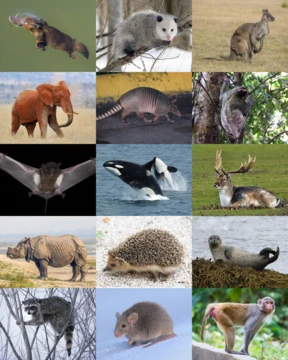
Hedgehog
Spiny mammal of Europe, Asia, and Africa.

A hedgehog is a spiny mammal of the subfamily Erinaceinae, in the eulipotyphlan family Erinaceidae. There are 17 species in five genera found throughout parts of Europe, Asia, and Africa, and in New Zealand by introduction. Hedgehogs have changed little over the last 15 million years and share distant ancestry with shrews. They are notable for their defensive spines, nocturnal habits, and ability to hibernate.
- Scientific classification
- Subfamily Erinaceinae, family Erinaceidae
- Number of species
- 17
- Genera
- 5
- Native range
- Parts of Europe, Asia, and Africa
- Introduced range
- New Zealand
- Lifespan in wild
- 2–7 years (larger species up to 16 years)
- Lifespan in captivity
- 8–10 years
Lore & Background
Hedgehogs are easily recognized by their spines, which are hollow hairs made stiff with keratin. They roll into a tight spiny ball when threatened, tucking in the furry face, feet, and belly. Hedgehogs are primarily nocturnal and sleep for a large portion of the day under bushes, grasses, rocks, or in dens dug underground. All wild hedgehogs can hibernate, though the duration depends on temperature, species, and abundance of food. Hedgehogs are fairly vocal, with a variety of grunts, snuffles and/or squeals. They occasionally perform a ritual called anointing: when encountering a new scent, they lick and bite the source, form a scented froth in their mouth, and paste it on their spines. Some experts believe this might serve to camouflage the hedgehog with the local scent and might also lead to infection of predators poked by the spines. Hedgehogs have some natural immunity against some snake venom through the protein erinacin in their muscles, though in such small amounts that a viper bite may still be fatal. They are one of four known mammalian groups with natural protection against α-neurotoxin. Hedgehogs are omnivorous, feeding on insects, snails, frogs, snakes, bird eggs, carrion, mushrooms, grass roots, berries, and melons.
Reader's Guide
Hedgehogs hold significance as a widely recognized mammal with a unique defensive adaptation of spines. They are commonly brought to wildlife clinics in Europe, where they are known to be sensitive and easily stressed by humans, sometimes fatally. Hedgehogs have been introduced as invasive species in areas such as New Zealand and the islands of Scotland, where they lack natural predators and have decimated native species including insects, snails, lizards, and ground-nesting birds. Eradication efforts have been controversial, with legal injunctions prohibiting killing in some areas. Hedgehogs are also kept as pets, with the most common pet species being hybrids of the white-bellied hedgehog and the North African hedgehog, though ownership is restricted in some US states and Canadian municipalities. They suffer from various diseases including cancer, fatty liver disease, and a rare condition called balloon syndrome, where gas is trapped under the skin.
Did You Know?
- Hedgehogs have changed little over the last 15 million years.
- Hedgehogs are one of four known mammalian groups with natural protection against snake venom α-neurotoxin.
- Hedgehogs can suffer from balloon syndrome, a rare condition where gas is trapped under the skin, unique to hedgehogs because their skin is baggy enough to curl up.
Frequently Asked Questions
What exactly is a hedgehog?
A hedgehog is a small, spiny mammal classified in the subfamily Erinaceinae within the family Erinaceidae. It is a nocturnal animal recognized for its quills, hibernation behavior, and a body plan that has stayed remarkably stable for roughly 15 million years.
Where in the world can you find hedgehogs?
Wild hedgehogs are native to parts of Europe, Asia, and Africa, with 17 species spread across five genera. They have also been introduced to New Zealand, where they now live outside their original range.
How long do hedgehogs typically live?
Most hedgehogs in the wild survive between two and seven years, though larger species can reach up to sixteen years of age.
What are hedgehog spines actually for?
The spines function as a primary defense, letting the animal curl into a quill-covered ball to deter predators. This quill-based protection is one of the most distinctive and well-known traits of the group.
How are hedgehogs related to shrews?
Hedgehogs and shrews share a distant common ancestor within the eulipotyphlan order, making them closer relatives to each other than to most other mammals. Despite that shared lineage, hedgehogs have kept a surprisingly unchanging body shape for about 15 million years.
More in Mammals 25-40
Elsewhere in the Mammals universe
Spotted an error? Know more?
This is a living reference — every entry is fact-audited, and reader corrections feed straight into our audit queue. Suggest an edit · See this site's audit record