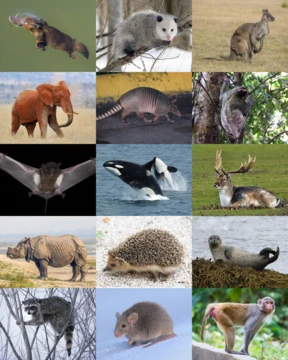
Mammal
Vertebrate class defined by mammary glands and three middle ear bones.

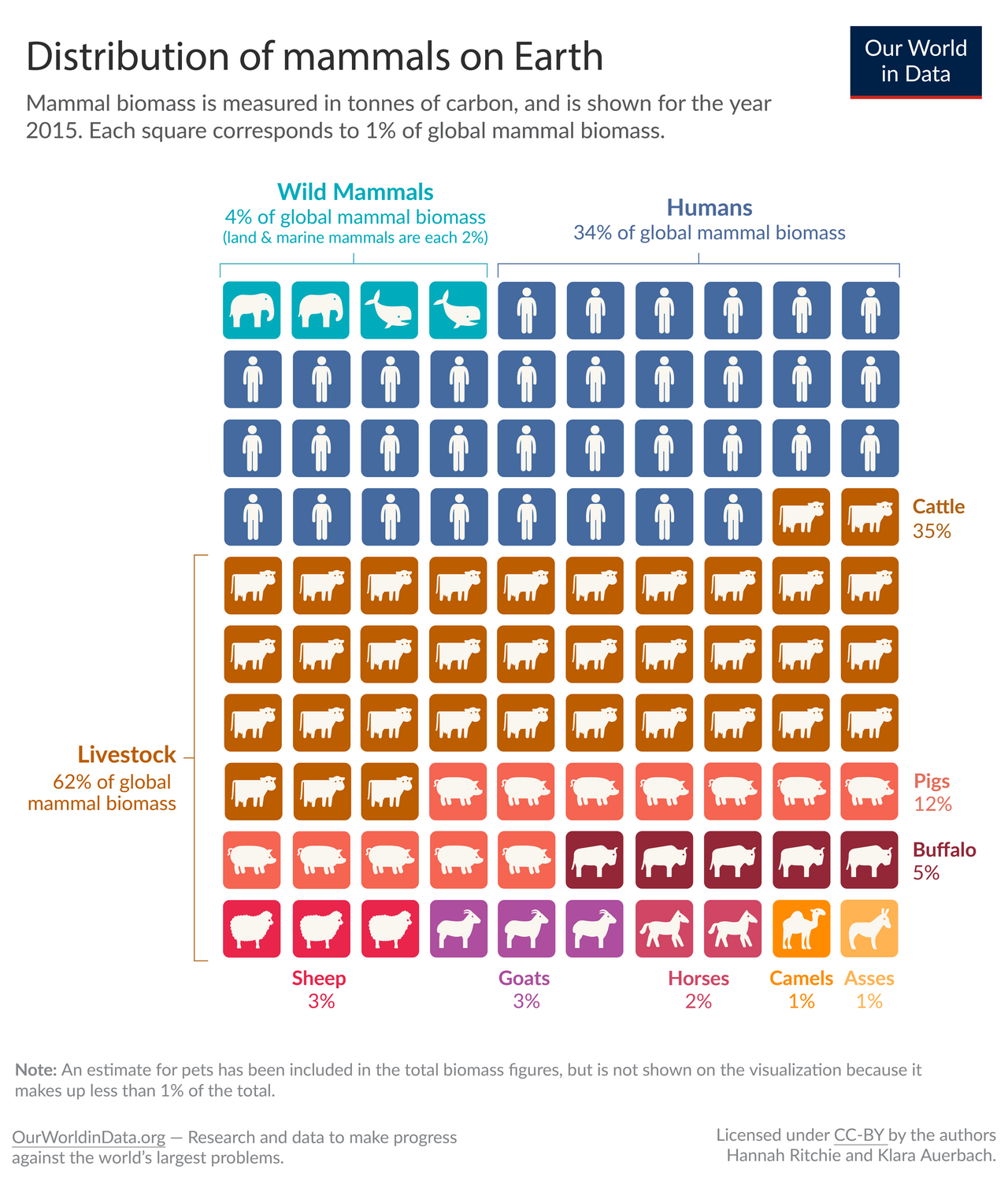
Hannah Ritchie and Klara Auerbach · CC BY 4.0
Mammals are vertebrate animals of the class Mammalia, characterized by milk-producing mammary glands, a neocortex, fur or hair, and three middle ear bones. They are the only living members of Synapsida and have been the dominant terrestrial animal group since the extinction of non-avian dinosaurs 66 million years ago. Mammals range from the bumblebee bat to the blue whale, and include humans, rodents, bats, and whales.
- class
- Mammalia
- number_of_extant_species
- ~6,640 (described, divided into 27 orders)
- earliest_known_fossil
- Tikitherium, dated 225 Ma (Late Triassic)
- key_characteristics
- Mammary glands, neocortex, fur/hair, three middle ear bones
- largest_orders
- Rodents, bats, eulipotyphlans, primates, even-toed ungulates, Carnivora
- size_range
- 30–40 mm (bumblebee bat) to 30 m (blue whale)
- lifespan_range
- 2 years (shrew) to 211 years (bowhead whale)
Lore & Background
Mammals originated from cynodonts, an advanced group of therapsids, during the Late Triassic to Early Jurassic. Early synapsids are referred to as 'pelycosaurs,' and the more advanced therapsids became dominant during the Guadalupian. Mammals achieved their modern diversity in the Paleogene and Neogene periods after the extinction of non-avian dinosaurs. The basic mammalian body type is quadrupedal, but limbs are adapted for sea, air, trees, or underground in some species. All modern mammals give birth to live young except the five species of monotremes, which lay eggs. The most species-rich group is viviparous placental mammals, named for the placenta used during gestation.
Reader's Guide
Mammals have played a major role in human history through domestication, which began during the Neolithic Revolution and led to farming replacing hunting and gathering as the primary food source. This shift enabled sedentary societies, larger cooperative groups, and the development of civilizations. Domesticated mammals provide power for transport and agriculture, as well as food, fur, and leather. Mammals are also hunted and raced for sport, kept as pets and working animals, and used as model organisms in science. They have been depicted in art since Paleolithic times and appear in literature, film, mythology, and religion. The decline and extinction of many mammals is primarily driven by human poaching and habitat destruction, especially deforestation. Molecular studies based on DNA analysis have suggested new relationships among mammal families, revealing three major placental lineages—Afrotheria, Xenarthra, and Boreoeutheria—which diverged in the Cretaceous.
Did You Know?
- The word 'mammal' derives from Latin 'mamma' meaning 'teat, pap,' coined by Carl Linnaeus in 1758.
- The largest mammal is the blue whale, reaching 30 meters, possibly the largest animal ever to have lived.
- Most mammals are intelligent, with some possessing large brains, self-awareness, and tool use.
- The three largest orders of mammals by species are rodents, bats, and eulipotyphlans.
What Makes a Mammal a Mammal
Mammals are vertebrate animals defined by a distinctive suite of biological traits that set them apart from every other group of living creatures. At the core of their identity are milk-producing mammary glands, which nourish newborn offspring; a broad neocortex region within the brain; a covering of fur or hair; and three small bones in the middle ear. These features collectively separate mammals from reptiles and birds, lineages from which their ancestors split during the Carboniferous period, more than three hundred million years ago. The basic body plan is quadrupedal, yet limbs have been reshaped over evolutionary time for swimming, flying, climbing, or burrowing. Size ranges are staggering: the bumblebee bat measures just thirty to forty millimetres, while the blue whale stretches to roughly thirty metres and may be the largest animal ever to have existed. Lifespans span from two years in a shrew to two hundred and eleven years in a bowhead whale. Nearly all modern species give birth to live young, though five monotreme species still lay eggs. The scientific study of these animals is known as mammalogy.
From Cynodonts to Dominance
Mammals occupy a unique position in the tree of life as the sole surviving members of the Synapsida clade. Together with Sauropsida, the group encompassing reptiles and birds, synapsids form the broader Amniota. The earliest synapsids, often called pelycosaurs, gave way to more advanced therapsids that became ecologically dominant during the Guadalupian stage. True mammals then emerged from cynodonts, a highly derived subgroup of therapsids, during the transition from the Late Triassic into the Early Jurassic. For millions of years, these early forms remained small and relatively obscure. The real explosion of mammalian diversity came in the Paleogene and Neogene periods of the Cenozoic era, after the mass extinction that wiped out non-avian dinosaurs. From roughly sixty-six million years ago onward, mammals have held the position of the dominant terrestrial animal group on Earth. In 1988, Timothy Rowe offered a phylogenetic definition of Mammalia as a crown group, anchoring the clade to the most recent common ancestor of living monotremes and therians, an ancestor that lived during the Jurassic and effectively excludes earlier Triassic fossils from the strict definition.
A Taxonomic Puzzle
No single classification system for mammals has achieved universal acceptance, and the field has seen repeated revisions since Carl Linnaeus first defined the class in 1758. Simpson's 1945 framework dominated teaching for decades, yet the rise of cladistics and accumulating paleontological evidence have steadily eroded its authority. More recent compendiums by McKenna and Bell in 1997 and Wilson and Reeder in 2005 offer updated alternatives, though debate persists. The six most species-rich orders all fall within the placental group. Rodents, including mice, rats, porcupines, beavers, and capybaras, lead in sheer numbers, followed by bats and the eulipotyphlans such as shrews, moles, and solenodons. Primates, even-toed ungulates including whales, and carnivores including cats, dogs, bears, and seals round out the next tier. Species counts have climbed steadily: 5,416 were catalogued in 2006, 5,488 in the IUCN's 2008 Global Mammal Assessment, and 6,495 by a 2018 Journal of Mammalogy study, a figure that includes ninety-six recently extinct species. The word mammal itself derives from the Latin mamma, meaning teat or pap, a nod to the defining reproductive trait.
Partners, Pests, and Prey
The relationship between mammals and humans stretches back to the Neolithic Revolution, when the domestication of animals transformed hunting and gathering into farming and reshaped societies from nomadic bands into sedentary civilizations. Domesticated mammals have long supplied transport power, agricultural labour, meat, dairy, fur, and leather, and they continue to serve as pets, racing animals, working beasts, and laboratory model organisms in scientific research. Mammals have also been a constant presence in human culture, appearing in Paleolithic cave art and persisting through literature, film, mythology, and religion. Their own social lives are remarkably varied: they form fission-fusion groups, harems, and strict hierarchies, or live solitary territorial lives. Mating systems range from polygyny to monogamy and even polyandry. Communication is equally diverse, spanning ultrasound, scent marking, alarm calls, song, echolocation, and, uniquely in humans, complex language. Yet this very closeness to human activity has proven deadly. The primary drivers of mammal population decline and extinction today are poaching and habitat destruction, with deforestation standing out as the most destructive force.
Gallery

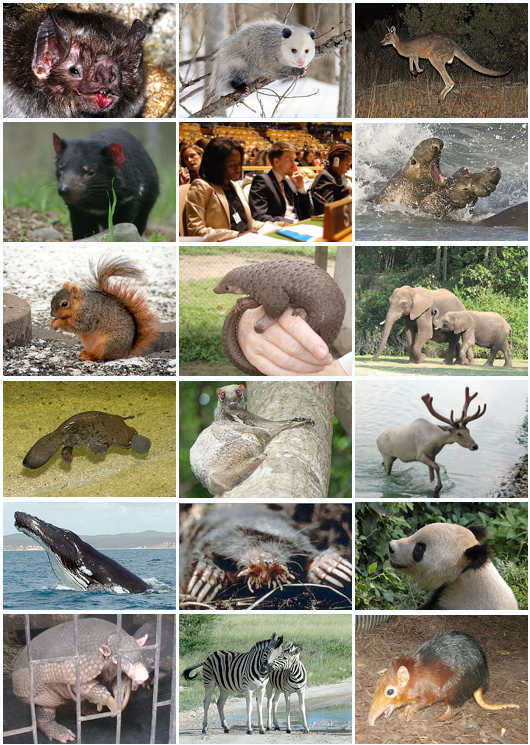
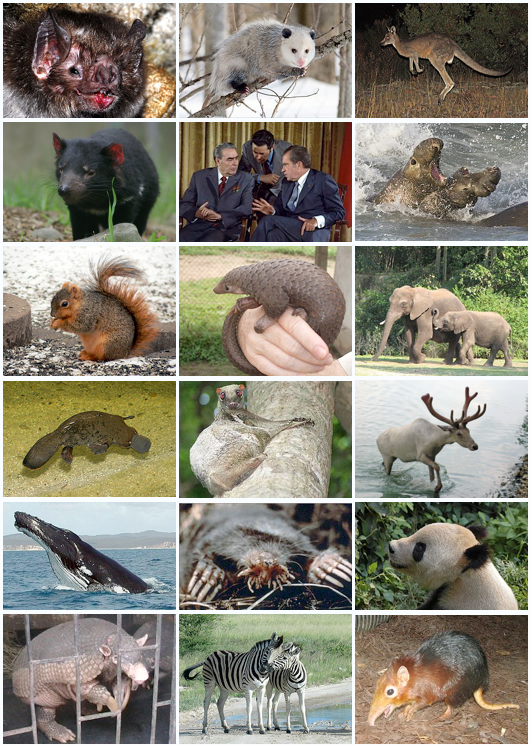

Frequently Asked Questions
What is Mammalia?
Mammalia is the vertebrate class that includes every species capable of producing milk via mammary glands. It is the sole surviving lineage of Synapsida and has held the dominant terrestrial niche since non-avian dinosaurs vanished roughly 66 million years ago.
How many mammal species are there today?
Scientists have described approximately 6,640 extant species, which are sorted into 27 distinct orders. The most species-rich orders are rodents, bats, eulipotyphlans, primates, even-toed ungulates, and Carnivora.
What traits uniquely define a mammal?
Every member of the class possesses mammary glands, a neocortex in the brain, some form of fur or hair, and three small bones in the middle ear. These features together separate mammals from all other vertebrate groups.
What is the earliest known mammal fossil?
The oldest recognized mammal fossil is Tikitherium, which dates to the Late Triassic around 225 million years ago. Its discovery pushes the origin of the class back well before the Cretaceous mass extinction.
How large can mammals get, and how small can they be?
The bumblebee bat, at roughly 30–40 mm, sits at the tiny end of the spectrum, while the blue whale stretches to about 30 m at the giant end. This makes Mammalia the most size-diverse class of vertebrates on Earth.
More in Mammals 25-40
Elsewhere in the Mammals universe
Spotted an error? Know more?
This is a living reference — every entry is fact-audited, and reader corrections feed straight into our audit queue. Suggest an edit · See this site's audit record