Galago
Small nocturnal primates native to sub-Saharan Africa.

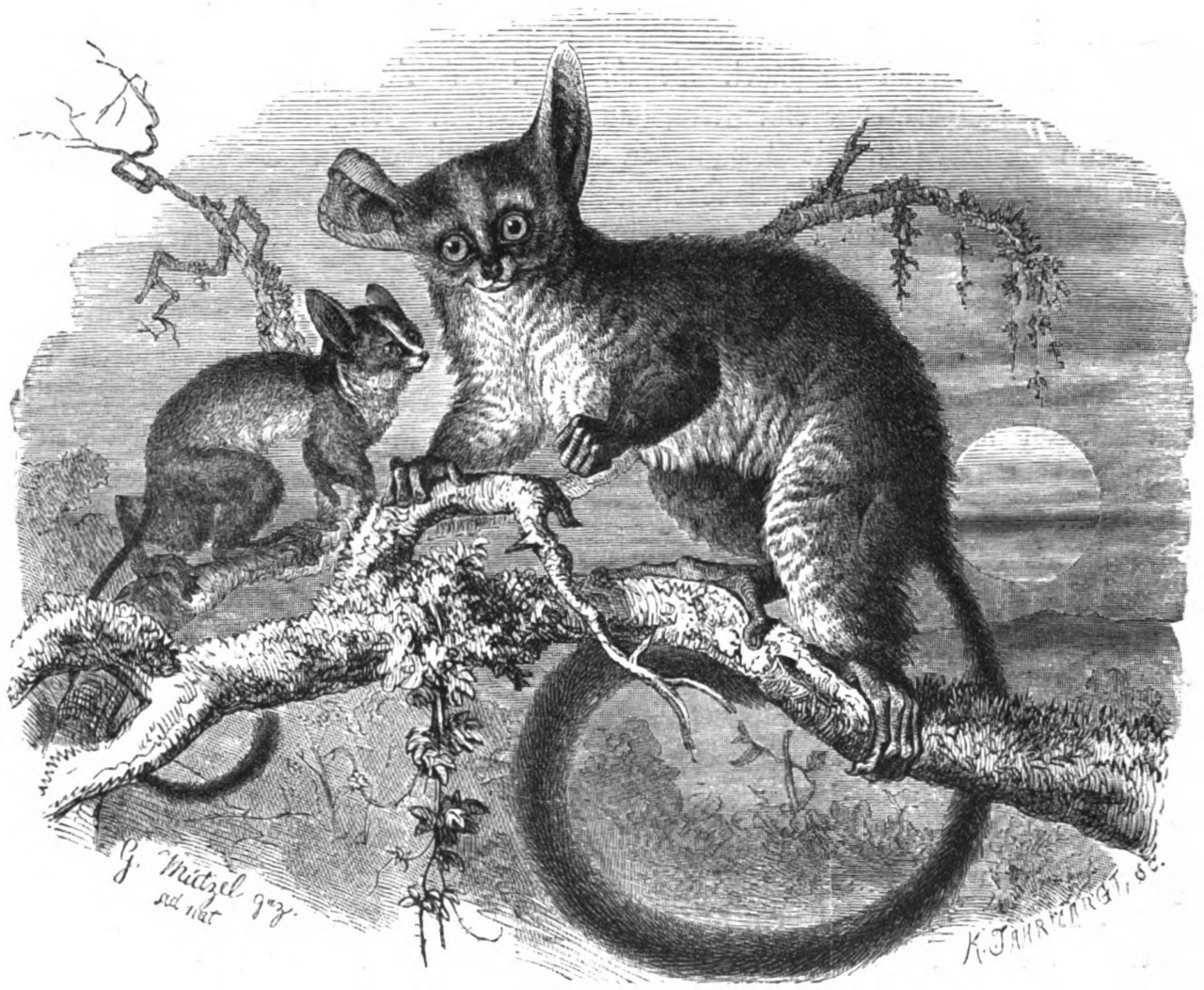
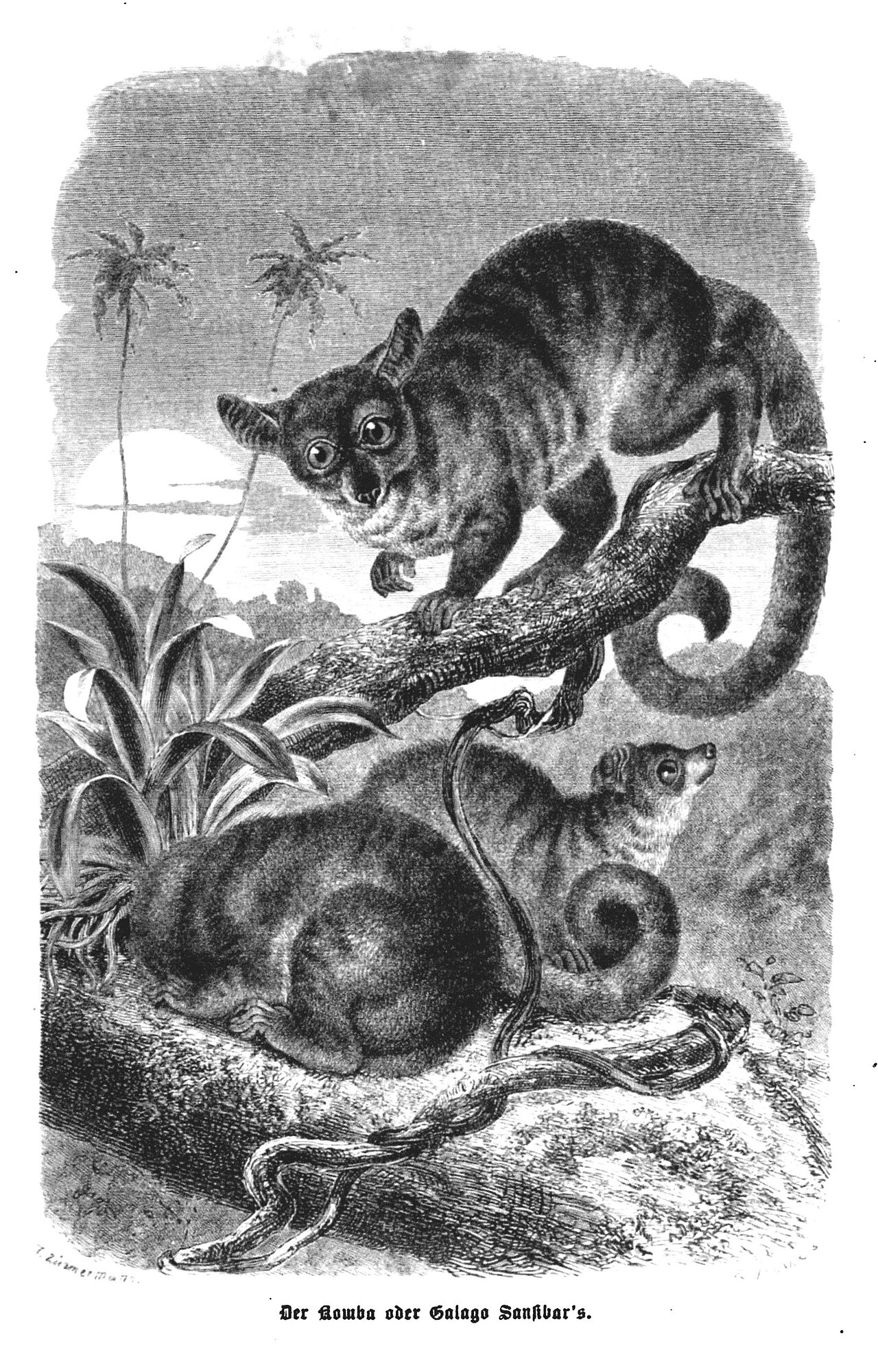
Drawing author: Theodor Franz Zimmermann (1808-1880)/Book author: Otto Kersten ( · Public domain
Galagos, also known as bush babies or nagapies (meaning 'night monkeys' in Afrikaans), are small nocturnal primates native to continental, sub-Sahara Africa, and make up the family Galagidae (also sometimes called Galagonidae). They are considered a sister group of the Lorisidae. According to some accounts, the name 'bush baby' comes from either the animal's cries or its appearance. The Ghanaian name aposor is given to them because of their firm grip on branches. In both variety and abundance, the bush babies are the most successful strepsirrhine primates in Africa, according to the African Wildlife Foundation.
- classification
- Family Galagidae (Galagonidae)
- common_names
- Galagos, bush babies, nagapies
- range
- Continental, sub-Sahara Africa
- activity
- Nocturnal
- diet
- Insects, other small animals, fruit, tree gums
- lifespan
- Captive lifetimes of 12.0 to 16.5 years; natural lifetime over a decade
Lore & Background
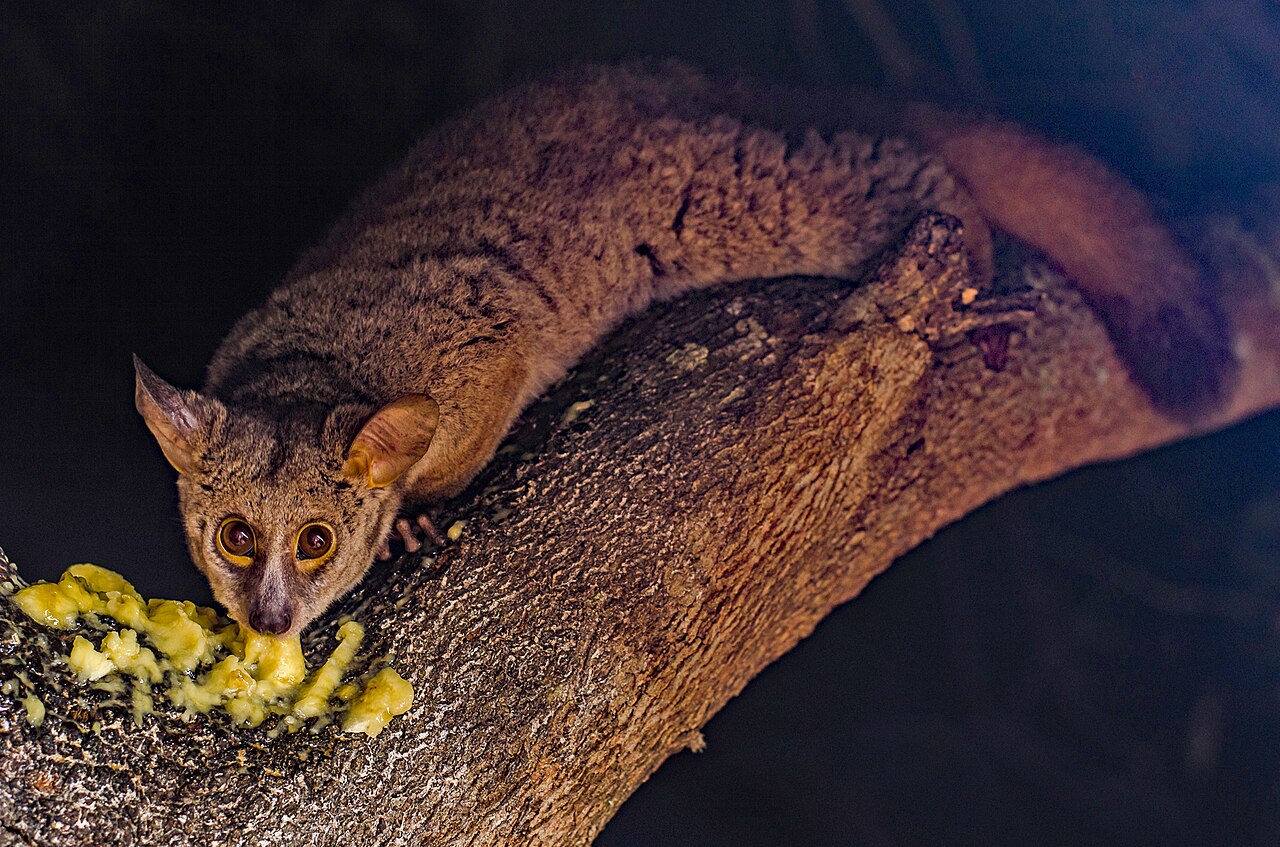
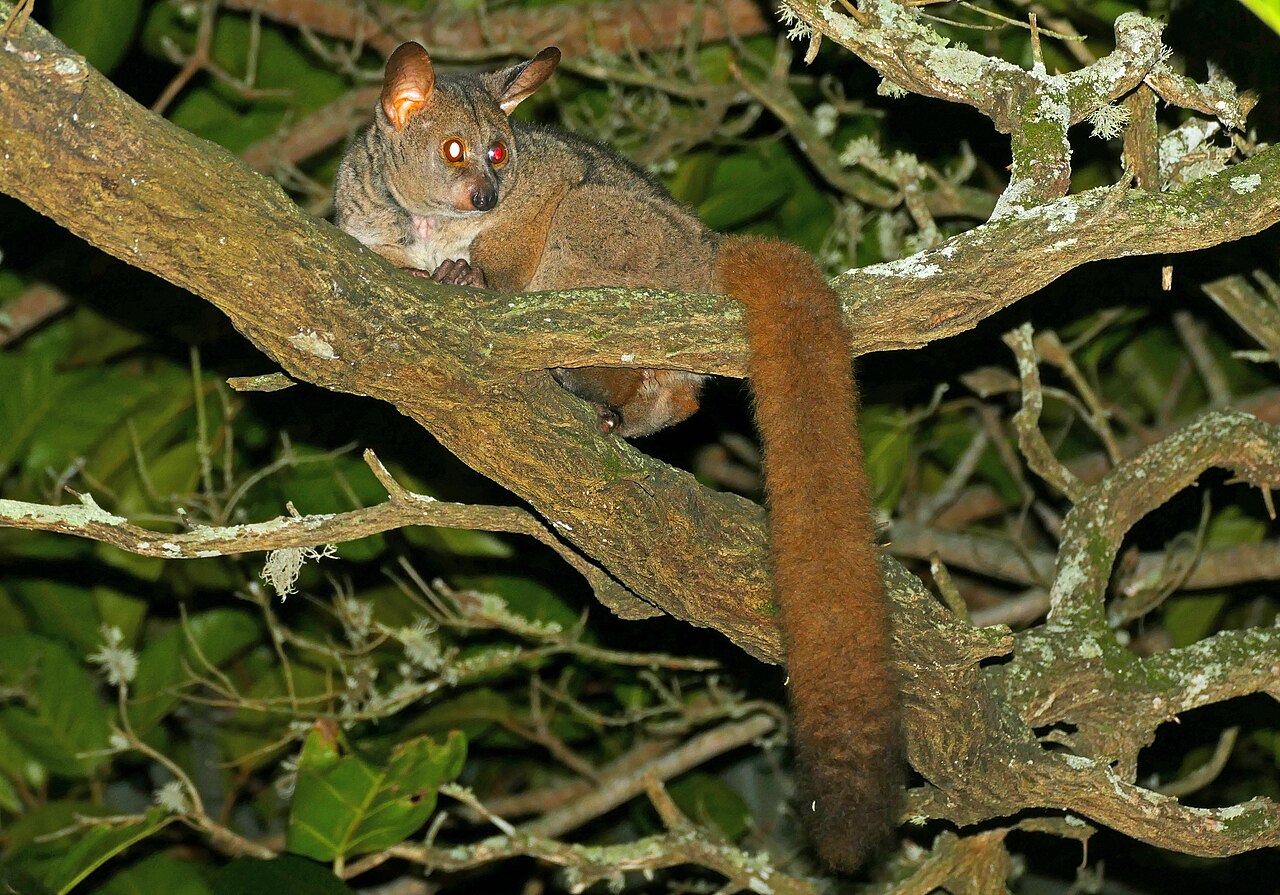
Galagos have large eyes for good night vision, strong hind limbs, acute hearing, and long tails that help them balance. Their bat-like ears allow them to track insects in the dark, and they catch insects on the ground or snatch them out of the air. As they bound through thick bushes, they fold their delicate ears back to protect them. They have nails on most digits except the second toe of the hind foot, which bears a grooming claw. Their diet is a mixture of insects, other small animals, fruit, and tree gums. They have pectinate incisors called toothcombs, and the dental formula: 2.1.3.3/2.1.3.3. After a few (6–8) days, the mother carries the infant in her mouth and places it on branches while feeding. Females may have singles, twins, or triplets. Each newborn weighs less than one-half ounce (14 g). The young are fed by the mother for six weeks and can feed themselves at two months. Females maintain a territory shared with their offspring, while males leave after puberty. Social groups consist of closely related females and their young; adult males maintain separate territories that overlap with those of the female social groups.
Reader's Guide
Galagos are significant as the most successful strepsirrhine primates in Africa in terms of variety and abundance. Their taxonomic classification has been refined by genetic data, vocalisation analysis, and morphology, revealing that the dwarf galagids formerly grouped under Galagoides actually consist of two distinct clades, with the eastern group elevated to genus Paragalago. Their remarkable jumping abilities—the highest reliably reported jump is 2.25 m—are due to elastic energy storage in tendons of the lower leg, allowing jumps far greater than expected for their size. Galagos communicate by calling and by marking paths with urine; each species produces a unique set of loud calls that scientists can use to identify all known galago species. They are sometimes kept as pets and are a likely source of diseases that can cross species barriers. The name 'bush baby' also refers to a myth used to scare children into staying indoors at night, based on their baby-like cry.
Did You Know?
- The Ghanaian name aposor refers to their firm grip on branches.
- Galagos fold their delicate ears back when bounding through thick bushes and during rest.
- Reliable sources typically cite jumps of up to 2.5–3 meters (about 8–10 feet) for many galago species.
- Each galago species produces a unique set of loud calls that scientists can recognize.
Taxonomic Diversity and Evolutionary Lineage
Galagos occupy a distinctive position among primates as the sister group to the Lorisidae family, yet they have achieved what the African Wildlife Foundation describes as the greatest variety and abundance of any strepsirrhine lineage on the African continent. Their family, Galagidae (sometimes rendered Galagonidae), is currently organized into six living genera, each representing a distinct evolutionary branch. Euoticus, the needle-clawed bushbabies, sits as the basal sister taxon to every other galagid, anchoring the family tree. The dwarf galagids, long lumped under a single genus, have been revealed through genetic, vocal, and morphological evidence to actually comprise two separate clades divided by the East African rift valley. The eastern clade was elevated to the genus Paragalago, while the western and central group remains basal to all non-Euoticus members. The greater galagos (Otolemur) and the squirrel galagos (Sciurocheirus) form a sister pair, completing a phylogeny that also includes two extinct genera, Laetolia and Pliogalago, offering glimpses into the family's deeper past.
Physical Adaptations and Extraordinary Locomotion
Built for a life of nocturnal acrobatics, galagos combine oversized eyes for keen night vision with bat-like ears capable of pinpointing insects in total darkness. Their strong hind limbs and tails—longer than the head and body combined—provide both balance and propulsion. Most digits bear nails, but the second hind toe carries a specialized grooming claw. Their mouths feature pectinate, comb-like incisors known as toothcombs, with a dental formula of 2.1.3.3/2.1.3.3. Perhaps their most striking trait is their jumping capacity. The highest reliably recorded leap reaches 2.25 meters, and a Royal Society study concluded that, relative to body mass, their leg muscles outperform a frog's by a factor of six to nine. This extraordinary power is attributed to elastic energy storage in the lower-leg tendons. Mid-flight, a galago tucks its limbs tightly against its body, then extends them at the final instant to seize a branch. In rapid succession, these leaps can carry the animal ten yards in mere seconds. The neurological basis for such coordinated movement lies in the rostral half of the posterior parietal cortex, which interfaces with motor and premotor regions.
Social Organization and Parental Care
Galago society is organized around female kinship. Females hold a shared territory with their offspring, while males depart their mothers' range after reaching puberty and establish their own, overlapping territories. Typically, a single adult male mates with every female within his area, though males who have not yet secured a territory may cluster into small bachelor groups. Reproduction follows a gestation of roughly 110 to 133 days, after which newborns arrive with half-closed eyes and weigh less than 14 grams. For the first three days the infant remains in constant contact with its mother. Around six to eight days later, the mother begins carrying the young in her mouth, depositing them on branches while she feeds. Litters can consist of one, two, or three pups, and mothers may display intense aggression during this period. Infants are nursed for about six weeks and become self-sufficient at two months. As the young grow rapidly, mothers are often seen walking in an awkward, lopsided gait as they transport their increasing weight.
Vocal Communication and Nocturnal Rhythms
Although silent to the untrained ear, galagos are remarkably vocal creatures. Each species produces a unique set of loud calls that serve to identify individuals as members of that particular species across considerable distances; in fact, researchers can distinguish every known galago species purely by its loud call. Beyond species-level identification, these vocalizations carry different functional purposes. At the close of each night, group members emit a special rallying call and converge on a shared sleeping site—a nest of leaves, a cluster of branches, or a hollow in a tree trunk. Movement through their territory is reinforced by urine marking, a chemical trail that allows a galago to land on precisely the same branch it used the previous night. During their active hours, these fast, agile primates fold their delicate ears back to shield them while bounding through dense undergrowth, a habit they also adopt during rest. Their diet blends insects caught on the ground or snatched mid-air with fruit and tree gums. In captivity, lifetimes of 12 to 16.5 years have been recorded, suggesting wild individuals also live well beyond a decade.
Gallery
Frequently Asked Questions
What is a Galago?
Galagos are small, nocturnal primates in the family Galagidae, also widely known as bush babies or nagapies. The Afrikaans nickname 'nagapies' translates roughly to 'night monkeys,' reflecting their strictly nighttime activity.
What do Galagos eat?
Their diet spans insects, other small animals, fruit, and tree gums, making them flexible omnivores. This varied feeding strategy is one reason they have become the most abundant and diverse strepsirrhine primates in Africa.
Where do Galagos live?
They are native to continental, sub-Saharan Africa, where they spend their waking hours climbing through forest canopies at night. In Ghana they are called aposor, a name that highlights their powerful grip on branches.
Why are they called 'bush babies'?
The common name is believed to come either from the distinctive vocal cries they emit or from their soft, appealing appearance. The exact origin of the phrase is debated, but it has stuck as the most recognizable English name for the group.
More in Mammals 25-40
Elsewhere in the Mammals universe
Spotted an error? Know more?
This is a living reference — every entry is fact-audited, and reader corrections feed straight into our audit queue. Suggest an edit · See this site's audit record