Gibbon
Agile tree-dwelling apes, known for brachiation and duet songs.
Gibbons, also known as the lesser apes, belong to the family Hylobatidae. This family was once considered a single genus but is now divided into four living genera and 20 species. These primates inhabit subtropical and tropical forests stretching from eastern Bangladesh and Northeast India through Southeast Asia and into Indonesia, including the islands of Sumatra, Borneo, and Java.
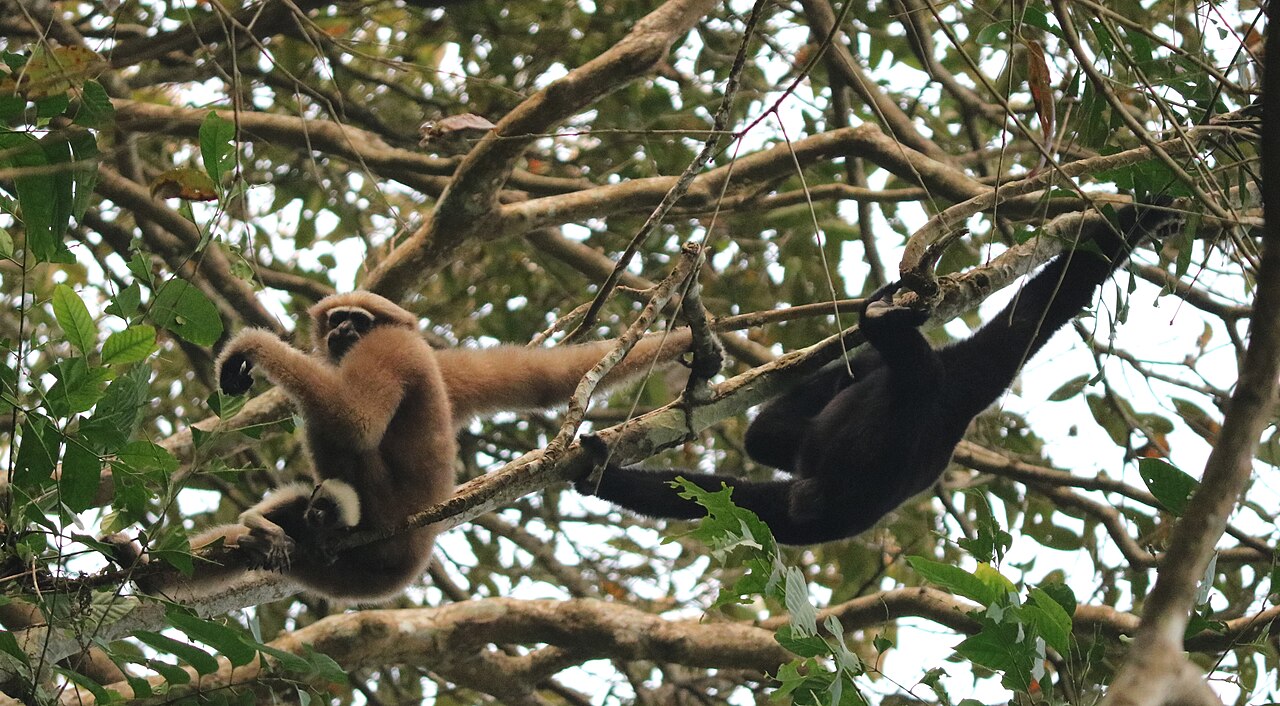
Unlike great apes—chimpanzees, gorillas, orangutans, and humans—gibbons are smaller, show little difference in size between males and females, and do not build nests. Like all apes, they lack tails. However, unlike most great apes, they often form long-term pair bonds. Their primary way of moving is brachiation: swinging hand over hand from branch to branch, covering distances up to 15 meters (50 feet) and reaching speeds of 55 km/h (34 mph). They can also leap up to 8 meters (26 feet) and walk upright on two legs with their arms raised for balance. This makes them the fastest of all tree-dwelling, nonflying mammals.
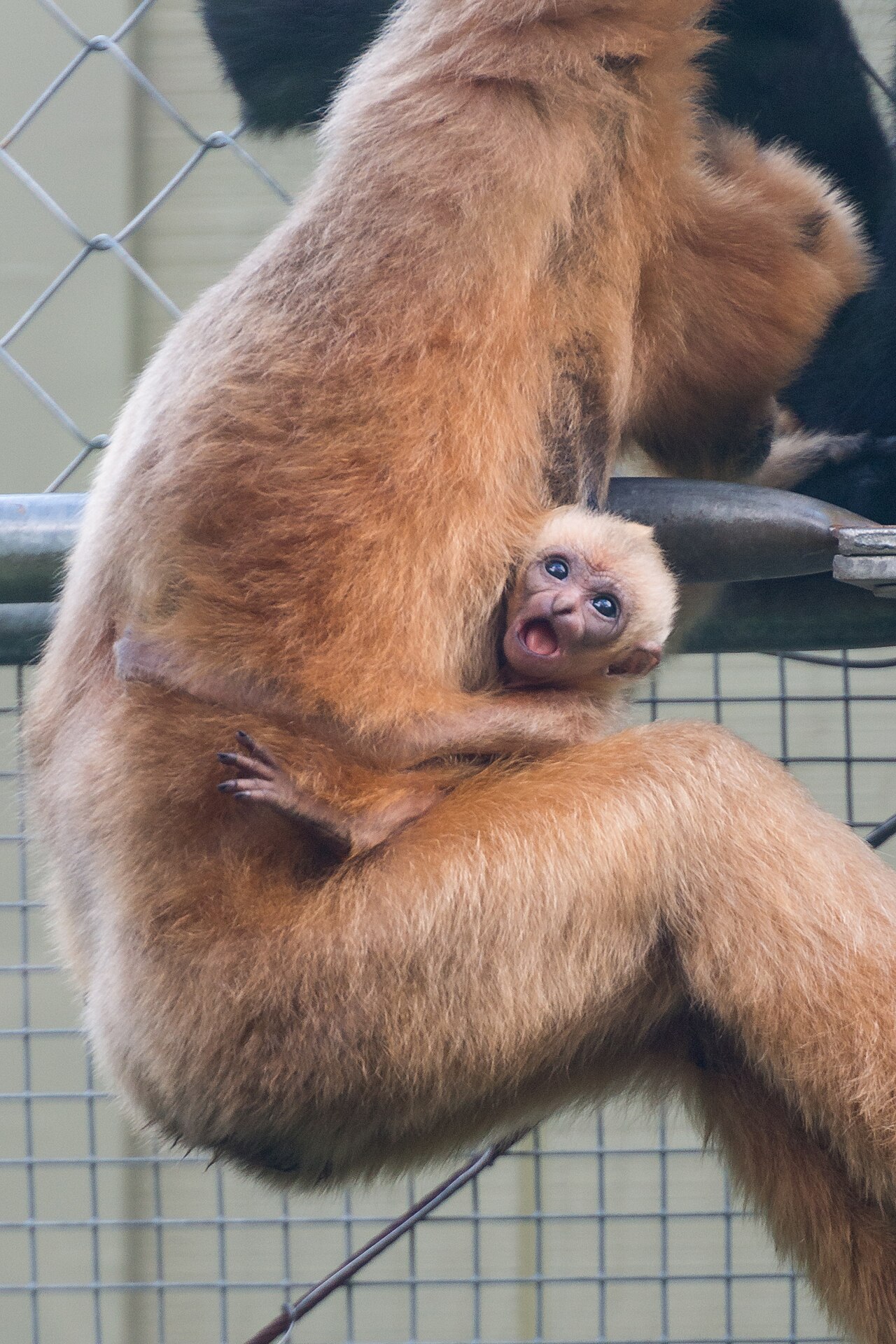
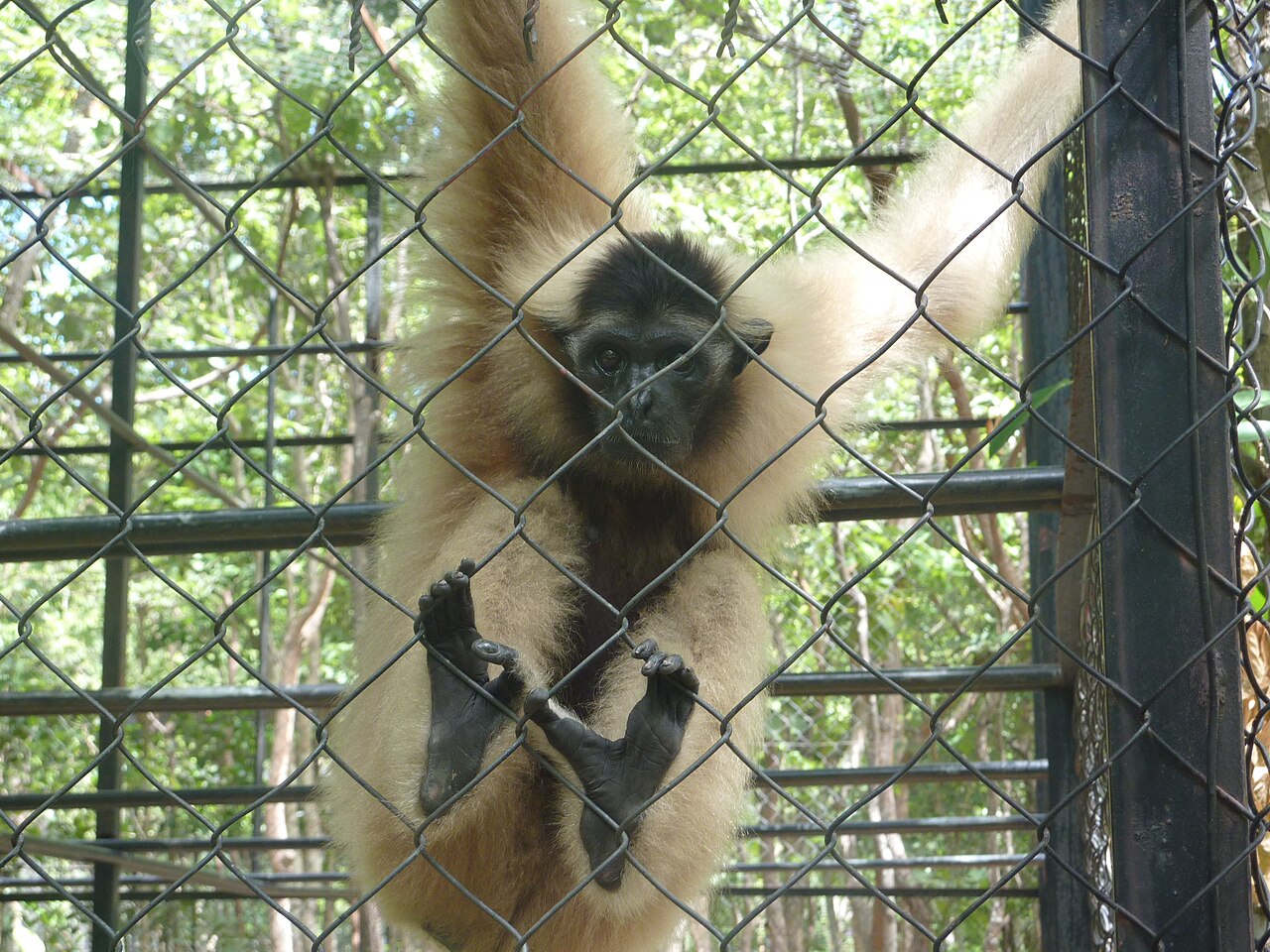
Fur color varies by species and sex, ranging from dark to light brown, and any shade between black and white, though a completely white gibbon is rare.
The English word "gibbon" comes from French and may originally derive from an Orang Asli word.
Genetic analysis shows that the gibbon lineage split from the great apes around 16.8 million years ago. A burst of adaptive change linked to chromosome rearrangements led to the rapid radiation of the four genera between 5 and 7 million years ago. Each genus forms a distinct lineage, but the exact order and timing of their divergences remain difficult to pin down, even with full genome data, due to rapid speciation and incomplete sorting of ancestral genes. One morphological analysis suggests the order (Symphalangus, (Nomascus, (Hoolock, Hylobates))), while a species tree analysis based on genome-scale data suggests (Hylobates, (Nomascus, (Hoolock, Symphalangus))). At the species level, mitochondrial DNA indicates that *Hylobates pileatus* diverged from *H. lar* and *H. agilis* around 3.9 million years ago, with *H. lar* and *H. agilis* separating around 3.3 million years ago. Whole genome analysis suggests *H. pileatus* split from *H. moloch* between 1.5 and 3.0 million years ago. The extinct *Bunopithecus sericus* is a gibbon or gibbon-like ape once thought to be closely related to hoolock gibbons.
The family is divided into four genera based on chromosome number: *Hylobates* (44), *Hoolock* (38), *Nomascus* (52), and *Symphalangus* (50). Three extinct genera are also recognized: *Bunopithecus*, *Junzi*, and *Yuanmoupithecus*.
Many gibbons are difficult to identify by fur color alone, so they are often identified by song or genetics. This has led to hybrids in zoos, where gibbons of unknown origin are commonly misidentified and housed together. Interspecific hybrids within a genus are also suspected in the wild where ranges overlap, but no fertile hybrids between different gibbon genera have been recorded.
A key feature of gibbon anatomy is the wrist, which acts like a ball-and-socket joint, allowing movement in two directions and reducing energy use in the upper arm and torso while easing stress on the shoulder. Gibbons have long hands and feet, with a deep cleft between the first and second digits. Their fur is typically black, gray, or brownish, often with white markings on hands, feet, and face. Some species, like the siamang, have an enlarged throat sac that inflates and acts as a resonating chamber for their calls. This sac can be as large as the animal's head. Their voices are far more powerful than any human singer's, even though they are at most half a human's height. Gibbon skulls and teeth resemble those of great apes, and their noses are similar to those of all catarrhine primates. The dental formula is 2.1.2.3/2.1.2.3. The siamang, the largest species, is distinguished by having two fingers on each foot fused together.
Like all primates, gibbons are social and strongly territorial, defending their boundaries vigorously.
- primary_locomotion
- Brachiation (up to 15 m swings, 15–20 km/h typical)
Lore & Background
Gibbons diverged from the great ape lineage around 16.8 million years ago, according to whole genome molecular dating. Adaptive divergence associated with chromosomal rearrangements led to rapid radiation of the four genera 5–7 million years ago. The sequence and timing of divergences among genera has been hard to resolve due to radiative speciations and incomplete lineage sorting, with different analyses suggesting different phylogenies. At the species level, estimates from mitochondrial DNA suggest Hylobates pileatus diverged from H. lar and H. agilis around 3.9 million years ago, while whole genome analysis suggests divergence of H. pileatus from H. moloch 1.5–3.0 million years ago. Gibbons are strongly territorial and defend boundaries with visual and vocal displays. Their vocal element, often a duet between a mated pair, can be heard for distances up to 1 km. Most species use solo songs to attract mates and advertise territories. Gibbons often retain the same mate for life, though they do not always remain sexually monogamous; about 10% of wild groups contain more than two adults. Their ball-and-socket wrist joints allow unmatched speed and accuracy in brachiation.
Reader's Guide
Gibbons are significant as the earliest apes to diverge from the common ancestor of humans and other great apes, providing a genomic bridge between Old World monkeys and great apes. Their genome shares 96% similarity with humans, and their karyotype diverged in a much more rapid fashion from the common hominoid ancestor than other apes. The family's taxonomy has been refined from one historical genus to four extant genera based on diploid chromosome number: Hylobates (44), Hoolock (38), Nomascus (52), and Symphalangus (50). Three extinct genera are also recognized: Bunopithecus, Junzi, and Yuanmoupithecus. Gibbons' ecological role as frugivores (about 60% fruit-based diet) and their seasonal preferences for non-fig fruits inform reintroduction and habitat protection efforts. Their long-term pair bonds and complex vocalizations make them a subject of study in primate social behavior. The difficulty in identifying species by fur coloration has led to hybrids in zoos and misidentification, though no fertile hybrids between different genera have been recorded. Their legacy includes being the fastest tree-dwelling nonflying mammals and having a wrist joint that functions like a ball-and-socket, reducing energy expenditure in brachiation.
Did You Know?
- Gibbons typically swing between branches at speeds of 15–20 km/h and can make leaps up to 8 m.
- The siamang, the largest gibbon species, has two fingers on each foot stuck together, reflected in its scientific name Symphalangus syndactylus.
- Gibbons' fur coloration varies from dark to light brown and any shade between black and white, though a completely white gibbon is rare.
- The English word 'gibbon' may originally derive from an Orang Asli word.
The Art of Brachiation
Gibbons are the fastest tree-dwelling, nonflying mammals on Earth, and their locomotion is a marvel of biomechanical engineering. Their primary mode of movement, brachiation, involves swinging from branch to branch across distances reaching fifteen meters, sometimes hitting speeds of fifty-five kilometers per hour. They can also execute leaps of up to eight meters and walk bipedally on the ground with their arms held aloft for balance. The secret to this extraordinary agility lies in their wrist, which functions almost like a ball-and-socket joint, permitting biaxial movement. This anatomical feature dramatically reduces the muscular effort required in the upper arm and torso while simultaneously easing stress on the shoulder joint. Their hands and feet are notably long, with a deep cleft separating the first and second digits of the hands. The siamang, the largest gibbon species, takes this anatomy a step further with a fused pair of toes on each foot, a trait that gives its genus name. Despite standing at best half the height of a human, gibbons possess vocal power that surpasses any human singer, aided in some species by an inflated throat sac that rivals the size of their own head.
Deep Roots: Evolutionary Divergence and Radiation
Molecular dating of whole genomes places the split between gibbons and great apes at roughly sixteen point eight million years ago, with a confidence interval spanning fifteen point nine to seventeen point six million years. This divergence itself followed a much earlier separation from Old World monkeys around twenty-nine million years ago. The gibbon family then underwent a rapid radiation between five and seven million years ago, driven by chromosomal rearrangements that produced four distinct extant genera. These genera are distinguished by their diploid chromosome counts: Hylobates carries forty-four, Hoolock thirty-eight, Nomascus fifty-two, and Symphalangus fifty. Resolving the precise sequence of their divergence has proven notoriously difficult, even with whole-genome data, because of radiative speciation and extensive incomplete lineage sorting. Morphological analyses suggest one ordering of the genera, while coalescent-based phylogenetic methods propose a different arrangement. At the species level, mitochondrial DNA indicates that the pileated gibbon separated from its close relatives around three point nine million years ago. Three extinct genera—Bunopithecus, Junzi, and Yuanmoupithecus—add further depth to the family's evolutionary story, with Bunopithecus sericus once thought to be a close relative of the hoolock gibbons.
Duet and Territory: Social Life in the Canopy
Gibbons are among the most socially distinctive of all apes. Unlike most great apes, they form long-term pair bonds, and their social structure revolves around these mated pairs. They are strongly territorial, defending their forest boundaries through vigorous visual and vocal displays. The vocal component is particularly striking: a duet performed by a bonded pair, sometimes joined by their young, can carry for up to one kilometer through the forest. In many species, males and some females also sing solo, using their voices both to attract mates and to broadcast territorial claims. Remarkably, a gibbon's song can identify not just the species but the specific area from which it originates, making each chorus a kind of acoustic fingerprint. These animals exhibit low sexual dimorphism, meaning males and females look quite similar, and unlike great apes they do not build nests. Their skulls and teeth closely resemble those of great apes, and their nasal structure aligns with all catarrhine primates. The English word "gibbon" itself is a reborrowing from French, potentially tracing back to an Orang Asli term, hinting at the deep human encounter with these animals across Southeast Asian cultures.
Twenty Species, One Puzzle: Diversity and Identification
The gibbon family encompasses twenty species spread across four extant genera, ranging from the subtropical and tropical forests of eastern Bangladesh and Northeast India all the way to the islands of Sumatra, Borneo, and Java in Indonesia. Their fur coloration spans an impressive spectrum—from dark to light brown, and any shade between black and white—though a truly all-white gibbon is rare. This wide morphological variation creates a persistent identification challenge. Many species are nearly impossible to distinguish by coat color alone, so researchers and zookeepers must rely on song or genetic analysis to confirm identity. In captivity, this problem has led to a troubling history of misidentification: zoos frequently receive gibbons of unknown origin, and animals are assigned species names based on unverifiable labels or superficial appearance. When different species are mistakenly housed together, interspecific hybrids can result. In the wild, similar hybridization is suspected where the ranges of different species within a genus overlap, though no fertile hybrids have ever been documented between different genera. The siamang, the largest of the species, stands apart with its fused toes, while the crested gibbons of the genus Nomascus display a range of cheek and crest colorations from black to yellow.
Gallery

Frequently Asked Questions
Who is Gibbon?
Gibbons are a group of small, tailless apes in the family Hylobatidae, commonly called the lesser apes. They are set apart from the great apes by their relatively small body size, long arms, and a lifestyle almost entirely spent in the forest canopy.
What are Gibbon's signature abilities?
Gibbons are best known for brachiation, a fluid arm-over-arm swinging gait that carries them through the treetops at roughly 15–20 km/h with individual leaps reaching up to 15 metres. This makes them among the fastest non-flying, tree-dwelling mammals on the planet.
Where do Gibbons live?
Their range spans subtropical and tropical forests, stretching from eastern Bangladesh and Northeast India across mainland Southeast Asia and out to the islands of Sumatra, Borneo, and Java.
How do Gibbons communicate?
Gibbons are celebrated for their elaborate duet songs, in which a bonded pair alternates and layers complex vocal phrases that can travel far across the canopy. These performances help defend territory and reinforce pair bonds.
Why is Gibbon important in the animal kingdom?
The family Hylobatidae now comprises four extant genera and 20 species, making it a key reference point for understanding primate evolution between the lesser and great apes. Their record-breaking brachiation speed also gives biomechanists a living benchmark for studying locomotion in non-flying mammals.
More in Mammals 1-24
Spotted an error? Know more?
This is a living reference — every entry is fact-audited, and reader corrections feed straight into our audit queue. Suggest an edit · See this site's audit record