Frequently Asked Questions
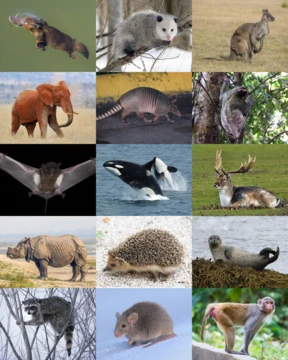
The most-asked questions about mammals.
What exactly is a mammal?
A mammal is a warm-blooded vertebrate in the class Mammalia, defined by the presence of mammary glands, a coat of hair or fur at some point in life, and a well-developed neocortex in the brain. Nearly all give live birth and nurse their young with milk produced by specialized glandular tissue.
How many species of mammals are there?
Taxonomists currently recognize roughly 6,400 to 6,500 living species distributed across 29 orders. That makes mammals a comparatively modest group in sheer species count, yet they occupy an outsized role in most ecosystems.
What traits do all mammals share?
The three universal hallmarks are mammary glands, hair or fur, and a middle ear built around three small ossicles (the malleus, incus, and stapes). Additional near-universal features include a four-chambered heart, a diaphragm that drives breathing, and a highly developed cerebral cortex.
What are the major orders of mammals?
The most species-rich and familiar orders include Rodentia (mice, rats, beavers), Carnivora (cats, dogs, bears), Chiroptera (bats), and Primates (monkeys, apes, humans). Other large or iconic orders are Cetacea (whales and dolphins), Artiodactyla (cattle, pigs, camels), and Perissodactyla (horses, rhinos).
Where do mammals live around the world?
Mammals occupy virtually every terrestrial biome, from polar tundra to tropical rainforest, and also colonize freshwater and marine habitats. As a class they are the most geographically widespread vertebrate group, with representatives on every continent including Antarctica (via penguins' prey chains) and most ocean basins.
What is the largest mammal?
The blue whale (Balaenoptera musculus) is the largest animal known to have ever existed, reaching roughly 30 metres in length and up to 170 tonnes in mass. On land, the African bush elephant holds the record, typically weighing between 4,000 and 7,000 kilograms.
What is the smallest mammal?
The bumblebee bat (Craseus alboniger) of the Philippines is generally regarded as the smallest, measuring only 3–4 centimetres and weighing about 0.8 grams. The closely related Kitti's hog-nosed bat is similarly tiny and was long listed as the record-holder before reclassification.
How do mammals reproduce and raise their young?
Most mammals are placental: the embryo develops inside the uterus, nourished through a placenta, and is then nursed with milk after birth. Monotremes such as the platypus and echidna lay leathery eggs, while marsupials deliver very underdeveloped neonates that crawl into a pouch to finish growing.
How did mammals evolve?
Mammals trace their lineage to small, shrew-like synapsids that diversified through the Triassic and Jurassic while dinosaurs held most large-bodied niches. The end-Cretaceous mass extinction 66 million years ago opened ecological space, triggering the rapid radiation that produced the modern mammal orders.
What are some surprising facts about mammals?
Humans are essentially the only mammals that have shed nearly all body hair and rely on evaporative sweating for cooling. Dolphins alternate sleeping with one brain hemisphere at a time so they can keep surfacing to breathe, and naked mole-rats can endure hours without oxygen by switching to a glucose-based metabolic mode.